
KO Million / México
Payouts and strategies
What does one more punch put at risk?
Start with the decision you actually control
A KO Million strategy needs to describe an action before the next result is known. That could mean collecting at a chosen step, keeping one stake size or ending a session after a stated budget is spent. It cannot mean looking at a successful fight afterwards and calling its exact exit point the plan. Write down the difficulty, stake and exit rule before comparing attempts, otherwise each result is answering a different question.
The practical distinction is between money already offered for collection and a larger conditional amount on the ladder. Continuing does not put only the extra prize at risk. If the next step fails and pays nothing, the available return disappears as well. The worksheet below makes that difference visible without pretending to know the chance that a punch succeeds.
Read the ladder after changing difficulty
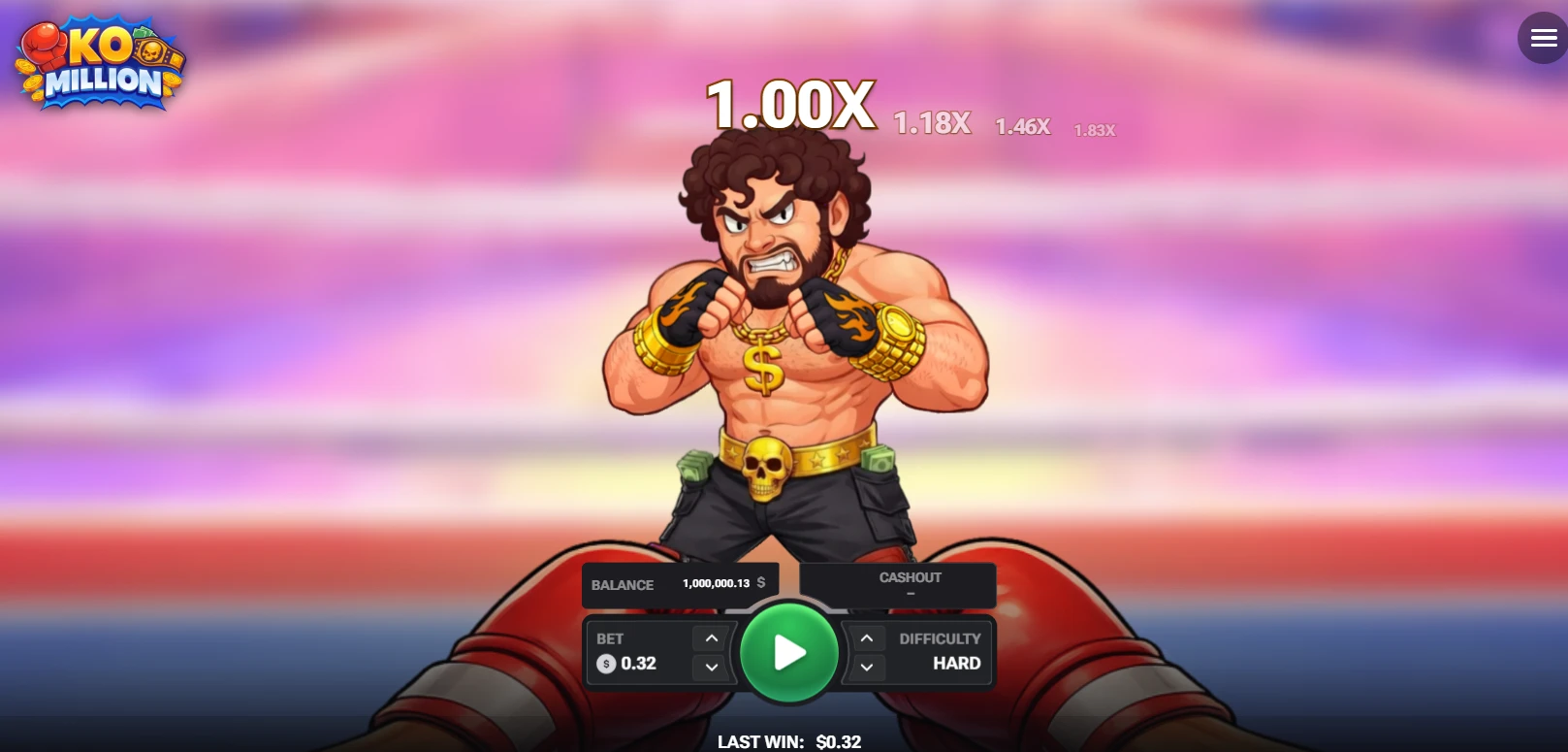
The public client we inspected opened at Medium and showed early positions including 1.00×, 1.08×, 1.21× and 1.37×. The official promotional image elsewhere in this guide shows Hard. Those are different settings: do not read the number of steps in one picture and apply it to the multiplier in another. After changing difficulty, inspect the new ladder before pressing GO.
A larger multiplier at the same visual position is an offered payout conditional on getting there. It is not evidence that the position is easier to reach. We have not collected enough completed fights to compare success rates across difficulties. That is why this guide compares the visible decisions and amounts, rather than declaring one level the most profitable.
Left, right and the limits of a pattern
LEFT and RIGHT let you choose an attack. A short sequence such as left-right-left can be written down and repeated, but repeatability of the input does not establish repeatability of the outcome. To evaluate a pattern, you would need a rule fixed before collection, complete losing attempts as well as wins, the same difficulty and a later sample that was not used to choose the pattern.
A video of a successful sequence supplies none of the missing losses. It can demonstrate where a control is and what the animation looks like; it cannot establish the probability of the next punch. Our controls page uses the original interface for that limited purpose. We have no verified finding that alternating hands or copying a prior winner improves the result.
Why doubling is not automatically recovery
A doubling system often borrows its arithmetic from a 2× gross return. At smaller returns, the same sequence behaves differently. Consider a purely illustrative first loss of MXN 10, followed by a MXN 20 stake collected at 1.21×. The second round returns MXN 24.20, but total stakes are MXN 30. The sequence is still MXN 5.80 down, despite the successful second fight.
Changing the next stake to repair that shortfall increases the amount exposed to another failure. It also requires enough balance and a stake that the loaded game will accept. The inspected demo limits are virtual USD, so they cannot be treated as the MXN account limits of a casino. A progression must be evaluated against both the return target and the actual limits; the word Martingale alone does not supply a working calculation.
Separate a session budget from turnover
Suppose your illustrative session starts with MXN 200 and uses MXN 10 per paid fight. Ten starts create MXN 100 of turnover, even if some returned credits are reused. That is different from making a new MXN 100 deposit. Your closing balance depends on the settled returns; the original budget and the total amount wagered answer different questions.
Decide what ends the session before it starts: a time boundary, an amount you are prepared to spend, or a chosen stopping balance. These controls limit your own participation; they do not identify a winning punch. Check the remaining budget before beginning another fight and keep money needed for other purposes outside that budget. A displayed prize that has not been collected is not money already removed from play.
Count complete fights, not individual punches
For a useful record, one row should contain the initial stake, difficulty, completed outcome and total return of one paid fight. Three successful punches after a single MXN 10 stake are not three new MXN 10 bets. Likewise, a display that rises from 1.08× to 1.21× to 1.37× is an updating state, not three separate awards to add together.
Include failed fights and interrupted attempts. If the interface disconnects, reconcile the final history before assigning a win or loss. A missing result should remain unresolved instead of being silently removed from a strategy report. We have inspected controls and official material, but this page does not claim a completed KO Million performance sample. The calculations below are reproducible arithmetic, not observed MXN results.
Use the calculation to ask a better question
The break-even percentage below compares continuing one step with taking the current offer, assuming failure returns zero. It is not the game’s RTP and not the probability supplied by the provider. If the current and next multipliers are equal, continuing would require a 100% success rate merely to match the immediate amount under that assumption. If you enter a smaller next multiplier, even a success would return less than collecting now.
Once the controls make sense, check the exact KO Million title, account currency and current limits at the destination. Our operator page distinguishes a public listing from tested account access. The partner route may lead to a different operator, so search the original INOUT title again rather than assuming the first screen or promotion is the same game.
What comes back, and what is profit?
Example: 100 at 1.5× returns 150; net profit is +50. This does not mean the game will reach 1.5×.
Hypothetical example in the displayed currency. Return = stake × multiplier; net profit = return − stake. Losing the whole stake makes net profit negative.
Published RTP · 95.5%
RTP is a theoretical long-run reference, not the percentage you will receive in a session. We have not calculated an observed RTP for this game.
What does one more punch put at risk?
Compare collecting now with one more step. The default 1.21× and 1.37× values were visible on the inspected Medium ladder. They are not success probabilities or recommended settings.
Example: MXN 100 at 1.21× can return MXN 121 now. A successful step to 1.37× would return MXN 137: only MXN 16 more, while MXN 121 remains at risk. The required success rate would be 88.32%. This does not establish that the game offers that probability.
If a failed next step returns zero, continuing risks the entire available cashout, not only the extra return. Break-even success rate = current multiplier ÷ next multiplier. This is the success rate that would be needed to match collecting now; we have not measured the actual probability. A negative extra return means the entered next value is lower. If the next multiplier is zero, the rate cannot be calculated.
Read the original controls and difficulty ladder →Explore available options
Affiliate link: we may earn a commission. The destination can vary; confirm game availability before depositing.